
Adding Customs Information to Inventory Items
In Order Dispatch, customs information is stored against each inventory item. When an export shipping label is printed, Order Dispatch reads the latest information saved against the items in the order and passes it to the courier for customs clearance.
This means that customs information can be corrected or completed before an order is processed, even where the order has already entered Order Dispatch. The latest saved information will be used when the label is generated.
Why Customs Information Matters
Customs authorities use product information to determine:
- what the goods are
- how they should be classified
- where they were manufactured
- whether restrictions, licences or special measures apply
- whether Customs Duty or import tax is payable
- whether a reduced or preferential duty rate may apply
The commodity code is particularly important because it is used to identify the product category and determine applicable taxes, duties, preferences and other customs measures.
Incorrect or incomplete information can result in:
- customs delays
- requests for additional information
- unexpected charges
- the wrong duty rate being applied
- the parcel being returned
- the shipment being held for manual inspection
Order Dispatch stores and transmits the information, but the seller or exporter remains responsible for ensuring that it is accurate.
How to Update Customs Information
Step 1: Open Inventory
Go to:
Inventory → Inventory
Search for the item using its:
- SKU
- barcode
- item title
Open the required inventory item.
Step 2: Open the Customs Information Tab
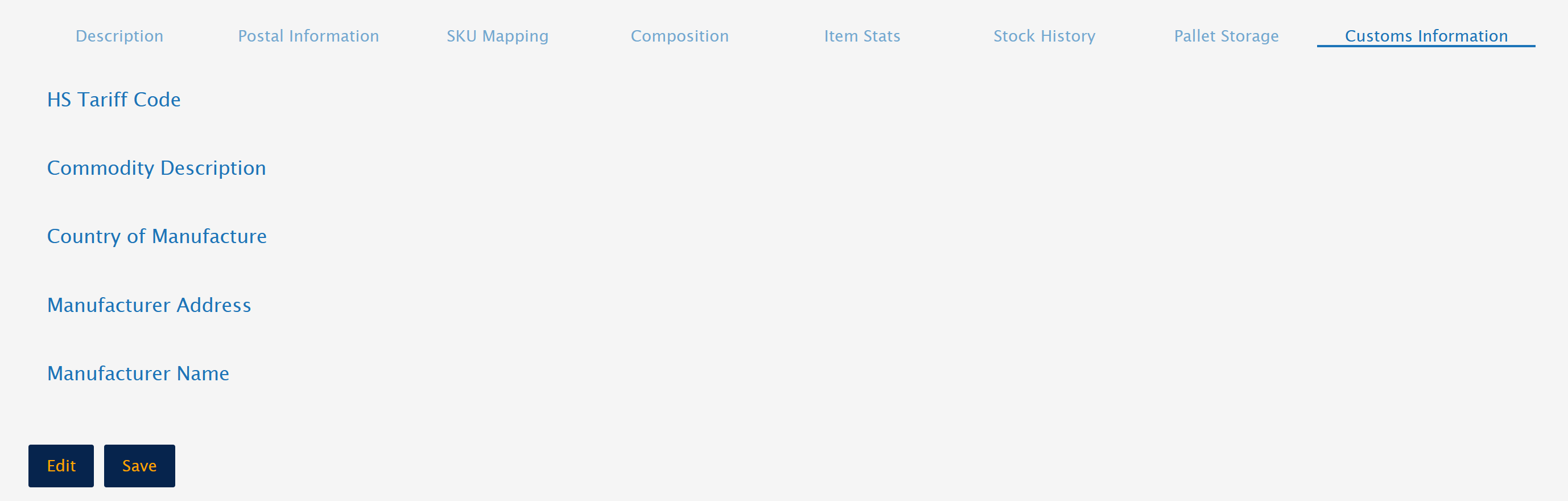
Select the Customs Information tab.
The following fields are available:
Field | Purpose |
|---|---|
HS Tariff Code | Classifies the product for customs purposes |
Commodity Description | Describes the physical goods being shipped |
Country of Manufacture | Identifies where the product was made or obtained its customs origin |
Manufacturer Address | Provides the manufacturer or responsible business address |
Manufacturer Name | Identifies the manufacturer or responsible business |
Step 3: Edit the Information
Click Edit.
Complete or correct the relevant customs fields, then click Save.
The updated information will be used the next time a shipping label and customs declaration are generated for an order containing the item.
Changing an inventory item does not rewrite customs documents that have already been generated. The updated information is used when a new label is created.
HS Tariff Code
What Is an HS Tariff Code?
An HS tariff code is a numerical code used to classify goods moving between countries.
You may also hear these referred to as:
- HS codes
- commodity codes
- tariff codes
- customs codes
- classification codes
Although these terms are often used interchangeably, the internationally harmonised part of the classification is the first six digits. Individual countries and customs territories may add further digits to provide more detailed national classifications.
The code tells customs what type of product is being imported or exported. It may affect:
- the Customs Duty rate
- import VAT or equivalent destination taxes
- preferential duty rates
- anti-dumping or safeguarding measures
- licences and restrictions
- quotas or suspensions
- additional declarations or supporting documents
HMRC describes commodity codes as internationally recognised reference numbers used to describe specific products on customs declarations.
How Many Digits Should Be Entered?
Order Dispatch accepts shorter codes, but we generally recommend entering the full 10-digit code where an appropriate 10-digit classification is available.
Using the full code provides the greatest compatibility across different courier systems and customs integrations.
Enter the code using:
- numbers only
- no spaces
- no full stops
- no dashes
- no other punctuation
For example, enter:
1234567890
Not:
1234.56.78.90
or:
1234-56-7890
The example above only demonstrates formatting; it is not a valid recommendation for a particular product.
Do not add arbitrary zeroes or guess additional digits merely to make a shorter code 10 digits long. The complete code must be the correct classification for the goods.
Where to Find a Tariff Code
For UK exporters, the official place to search is the UK Trade Tariff.
The Trade Tariff allows you to search for a commodity code and check related measures, such as duty, VAT, restrictions and possible reductions. To classify a product correctly, you may need to know:
- what the product is
- what it is used for
- what it is made from
- how it was manufactured
- how it is presented or packaged
These details can affect where the product appears in the tariff.
When searching, start with a plain description of the product and then follow the available categories until you reach the most specific applicable classification.
Information You May Need Before Searching
The correct classification may depend on details that are not obvious from the product name alone.
For clothing, this might include:
- the material
- whether it is knitted or woven
- the type of garment
- the intended wearer
- whether it is a complete garment or part of one
For footwear, it may include:
- the upper material
- the sole material
- whether it covers the ankle
- the intended use
For an electrical product, it may include:
- its primary function
- power source
- output or capacity
- whether it is a complete product or component
A title such as Black Boots or Phone Accessory will not normally contain enough information to classify the product confidently.
Can You Use a Supplier’s Code?
A code provided by a manufacturer or supplier can be a useful starting point, but it should still be checked.
Only the first six digits are normally harmonised internationally. Additional digits and product-specific classification decisions can vary between countries. HMRC therefore advises businesses to check how an overseas supplier’s code applies in the UK rather than assuming the complete code is identical.
This is particularly important where the supplier has provided:
- a US HTS code
- an EU TARIC code
- a code from another national tariff
- only a broad six-digit HS classification
When Classification Is Unclear
Some goods are difficult to classify, particularly products that:
- contain several materials
- have more than one possible use
- are sold as sets
- include accessories
- are parts of a larger product
- combine electronics with another function
Do not choose a code purely because it sounds approximately correct or because a similar product uses it.
Where the classification is uncertain, review the official classification guidance or obtain advice from a customs specialist or broker. The exporter remains responsible for the code supplied to the courier.
Commodity Description
What Is a Commodity Description?
The commodity description is a clear, plain-English description of the physical goods being sent.
It should allow a customs officer to understand what the item is without needing to recognise:
- your SKU
- the brand name
- the website product title
- an internal abbreviation
- a marketing name
A good description normally identifies:
- what the product is
- what it is primarily made from
- any other detail needed to distinguish it from similar goods
The type, use and materials of a product are also among the details HMRC recommends considering when finding its commodity code.
Good Description Examples
Too vague | Better description |
|---|---|
Clothing | Women’s cotton knitted T-shirt |
Shoes | Men’s leather ankle boots |
Toy | Children’s plastic construction toy set |
Accessory | Plastic mobile phone case |
Parts | Stainless steel replacement cabinet hinge |
Furniture | Wooden dining chair |
Kitchen item | Stainless steel kitchen scissors |
Gift set | Scented wax candles in glass jars |
Baby clothes | Cotton baby sleepsuit |
Bag | Women’s polyurethane shoulder bag |
These are examples of suitable structure only. The material, purpose and product type must match the actual item being shipped.
Descriptions to Avoid
Avoid descriptions such as:
GoodsMerchandiseProductsGiftSamplePartsAccessoryClothingItem 123- the SKU by itself
- a brand name by itself
For example, ABC-001 may be meaningful inside your business, but it does not tell a customs authority what is inside the parcel.
Similarly, Gift describes the reason for sending something, not the item itself. A parcel may be a gift, but customs still needs to know whether it contains a cotton T-shirt, a wooden toy or a stainless steel utensil.
How Long Should the Description Be?
There is no fixed Order Dispatch character limit for the commodity description, but it should remain concise.
A useful description is normally a short phrase rather than a full product listing.
For example:
Good:Women's leather ankle boots
Unnecessarily long:Premium fashionable black women's genuine leather ankle boots with side zip, decorative buckle and comfortable cushioned sole
The shorter version contains the information relevant to identifying the goods without unnecessary marketing language.
The Description and Tariff Code Should Agree
The description should be consistent with the selected tariff code.
For example, avoid situations where:
- the description says cotton but the tariff code is for synthetic garments
- the description says plastic but the code is for metal goods
- the description says shoes but the code relates to clothing
- the description says a complete product but the code is for parts
A clear description does not correct an inaccurate tariff code, and an accurate tariff code does not compensate for an unusably vague description. Both should describe the same physical product.
Country of Manufacture
What Does Country of Manufacture Mean?
The country of manufacture is the country in which the item was produced, manufactured or obtained its customs origin.
It is not necessarily:
- the country from which it was dispatched
- the location of the warehouse
- the country in which the seller is based
- the country from which it was purchased
- the location of the brand owner
GOV.UK guidance explains that origin is where goods have been grown, produced or manufactured, and may not be the country from which they were shipped or purchased.
Example
A UK company designs a T-shirt and stores it in a UK fulfilment warehouse, but the T-shirt was manufactured in India.
The country of manufacture is:
India
It does not become a UK-origin product merely because:
- it is owned by a UK company
- it has a UK brand
- it was imported into the UK
- it is dispatched from a UK warehouse
Products Made Using Parts From Several Countries
For goods made using materials or components from more than one country, determining origin can be more complicated.
Depending on the applicable origin rules, the result may depend on:
- where the product was substantially manufactured
- whether its tariff classification changed
- the value added during production
- whether a required manufacturing process took place
- the product-specific rule in a relevant trade agreement
Rules of origin determine a product’s “economic nationality,” and the country of manufacture may differ from the country from which the goods are shipped. Preferential origin can also determine whether goods qualify for reduced tariff treatment under a trade agreement.
Simple actions such as storing, redistributing, relabelling or repacking imported goods do not automatically make them UK-origin goods.
Entering the Country in Order Dispatch
The Country of Manufacture field is currently free text.
Enter a clear and consistent country name, such as:
- United Kingdom
- India
- China
- Turkey
- Portugal
- Vietnam
Avoid inconsistent entries such as using UK, United Kingdom, GB and Great Britain for different items manufactured in the same country.
Where the country is not known, confirm it with the supplier or manufacturer rather than guessing.
Manufacturer Name and Address
The manufacturer fields identify the company responsible for manufacturing the product.
Where known, enter:
- the manufacturer’s trading or legal name
- its full address
- town or city
- postcode or equivalent
- country
These fields are used less frequently than the tariff code, description and country of manufacture, but they should still be completed.
Where the actual manufacturer details are unavailable, the practical fallback in Order Dispatch is to enter your own business or brand-owner details rather than leaving the fields blank.
However, where a destination country or regulated product category specifically requires the actual manufacturer, producer or responsible economic operator, the legally required details should be used.
When Order Dispatch Reads the Information
Order Dispatch reads the customs information at the exact time the shipping label is printed and the order is processed.
This has two important consequences:
Updates can affect existing open orders
If an order has already entered Order Dispatch but its label has not yet been printed, updating the inventory item will change the information used when that order is processed.
The latest saved information is used
The customs information is not permanently copied from the item when the order first arrives. Order Dispatch retrieves the latest saved information when generating the courier request.
This is helpful when correcting missing or inaccurate data before dispatch.
How Customs Information Affects Duties and Taxes
The amount charged at import is not normally determined by one field alone.
Customs authorities may consider several factors together.
1. Product Classification
The tariff code identifies the product category.
It may determine:
- the standard duty rate
- reduced or suspended rates
- quotas
- anti-dumping measures
- import restrictions
- licensing requirements
The UK Trade Tariff can be used to check the measures associated with a commodity code.
2. Country of Origin
The country of origin may affect whether:
- a trade agreement applies
- a preferential duty rate is available
- additional duties apply
- a product is subject to country-specific restrictions
- evidence or proof of origin is required
Goods that meet the relevant rules of origin may qualify for preferential tariffs. Goods that do not meet those rules can still be traded, but may instead be charged the destination’s standard tariff.
Entering a country in Order Dispatch does not, by itself, prove that the goods qualify for a preferential rate. The exporter or importer may also need supporting origin evidence under the relevant trade agreement.
3. Customs Value
The declared value of the goods is generally used as part of the calculation of Customs Duty and import taxes.
Depending on the destination and its rules, the customs value calculation may also take account of amounts such as:
- transport
- insurance
- commissions
- packing costs
- other charges connected with bringing the goods to the destination
The tariff code determines which rate may apply, while the customs value provides the financial amount to which that rate is applied.
The exact valuation rules and tax calculations vary by destination, so the current requirements of the importing country should be checked.
4. Destination Country
Each destination applies its own:
- tariff schedule
- tax rates
- low-value thresholds
- exemptions
- customs procedures
- product restrictions
- trade agreements
A product may therefore attract different charges when sent to different countries, even where its description, value and country of origin remain the same.
Tariff Rates Can Change
The applicable tariff rate, customs measure or preferential arrangement can change over time.
For this reason:
- use the current tariff rather than relying permanently on an old lookup
- review codes where products or materials change
- check classifications received from overseas suppliers
- periodically review important or high-volume products
The article should not be treated as a permanent statement of the duty rate for a particular item. The current tariff and destination-country rules remain the authoritative sources.
Incoterms: Who Is Responsible for Import Charges?
Incoterms are internationally used trade terms that allocate responsibilities, costs and risks between a seller and buyer.
They do not decide:
- the tariff code
- the duty rate
- the product’s origin
- the customs value
Instead, they help determine who is responsible for matters such as transport, customs formalities, duties and taxes.
The current ICC rules include 11 Incoterms, but the two most commonly encountered in parcel-based ecommerce are DAP and DDP.
DAP — Delivered at Place
Under DAP, the seller arranges delivery to the agreed destination, but the buyer is responsible for import customs clearance and the associated import duties and taxes.
In practice, the recipient may receive a request from the courier to:
- provide information
- pay duties or taxes
- authorise customs clearance
The parcel may not be released for final delivery until those requirements have been completed.
Under DAP, the seller is still responsible for providing accurate customs information for the shipment.
DDP — Delivered Duty Paid
Under DDP, the seller is responsible for import clearance and the applicable import duties and taxes, as well as export and transit formalities.
The intention is normally that the recipient receives the shipment without being asked by the courier to pay import charges at the border.
DDP places considerably more responsibility on the seller. The seller must ensure that:
- the courier supports DDP for the destination
- duties and taxes can be billed correctly
- any importer-of-record requirements are satisfied
- the seller is permitted to complete import formalities in that country
Some destinations can make it difficult or impossible for a foreign seller to act under a true DDP arrangement. ICC guidance notes that DAP may be more appropriate where the seller cannot perform the destination-country import formalities.
Customs Information Is Required Under Both
Choosing DDP does not remove the need for:
- an accurate tariff code
- a clear commodity description
- the correct country of manufacture
- a correct declared value
The same customs information is required to calculate and clear the charges; DDP primarily changes who is responsible for dealing with and paying them.
Likewise, sending DAP does not transfer responsibility for poor data to the customer. The exporter must still provide an accurate declaration.
Updating Customs Information in Bulk
Where many inventory items need updating, the customs fields can also be maintained through the standard Inventory CSV or Excel import routine.
This is useful when:
- onboarding a large catalogue
- completing previously blank customs fields
- correcting codes supplied by a manufacturer
- updating the country of manufacture for many items
- migrating product data from another system
Use the current inventory import template and ensure each row identifies the correct inventory item, normally through its SKU.
Before uploading a large update:
- Keep a copy of the original data.
- Test the import with a small number of items.
- Check that tariff codes remain stored as text or full numbers and have not been converted to scientific notation.
- Confirm that leading zeroes have not been removed by Excel.
- Review several items in Order Dispatch after the import.
Leading zeroes can be significant in a commodity code, so spreadsheet columns containing tariff codes should normally be formatted as text.
Common Mistakes
Using the dispatch country as the origin
A product dispatched from the UK is not necessarily manufactured in the UK.
Use the actual country of manufacture or origin.
Entering a vague description
Descriptions such as gift, parts or merchandise do not identify the product.
State what the item is and what it is made from.
Entering punctuation in the tariff code
Use numbers only.
Do not include:
- spaces
- full stops
- dashes
- slashes
Guessing the final digits
Do not pad a six- or eight-digit code with arbitrary zeroes.
Use the correct full classification where available.
Assuming an overseas code is identical
The first six digits may be harmonised, but later national digits can differ.
Check the product in the relevant tariff.
Confusing the seller with the manufacturer
The seller, brand owner, importer, warehouse and manufacturer may all be different businesses.
Use the actual manufacturer details where known. Where they are unavailable, use the responsible business details as the practical fallback in Order Dispatch.
Assuming DDP changes the duty rate
DDP changes who is responsible for import formalities and charges. It does not turn a dutiable product into a duty-free product.
Classification, origin, value and destination rules still determine the customs treatment.
Updating the item after documents have been generated
Order Dispatch uses the latest information when the label is printed. Changes made afterwards do not rewrite paperwork already supplied to the courier.
Review customs information before processing the order.
Recommended Customs Information Checklist
Before shipping an item internationally, confirm that:
Check | Requirement |
|---|---|
Tariff code | Correct for the actual product and entered as numbers only |
Code length | Full 10-digit code used where available and appropriate |
Description | Clearly states what the item is and its main material |
Origin | Reflects where the product was manufactured, not where it is stored |
Manufacturer | Name and address completed where available |
Declared value | Accurate and commercially supportable |
Delivery terms | DDP or DAP arrangement understood and supported |
Current guidance | Tariff and destination rules checked where necessary |
Responsibility for Customs Data
Order Dispatch passes the saved information to the selected courier, but it does not determine whether the classification, origin or description supplied by the user is legally correct.
The seller or exporter remains responsible for:
- classifying the product
- declaring its origin accurately
- supplying a truthful description
- providing a correct customs value
- retaining any required supporting records
- complying with destination-country requirements
Where there is uncertainty, obtain guidance from the relevant customs authority, a customs broker or a qualified trade specialist before shipping.
Accurate inventory customs data reduces manual work, gives couriers better information and helps international orders move through customs as smoothly as possible.